
Capture
Drone, CCTV, robot or a phone. Images or video — the pipeline does not care which.
Structural screening from a photograph.
In development ↗Drone, CCTV and handheld imagery in. Located defects, ranked severity, and a report an engineer can act on — out.
First-pass screening. Findings require confirmation by a qualified engineer.
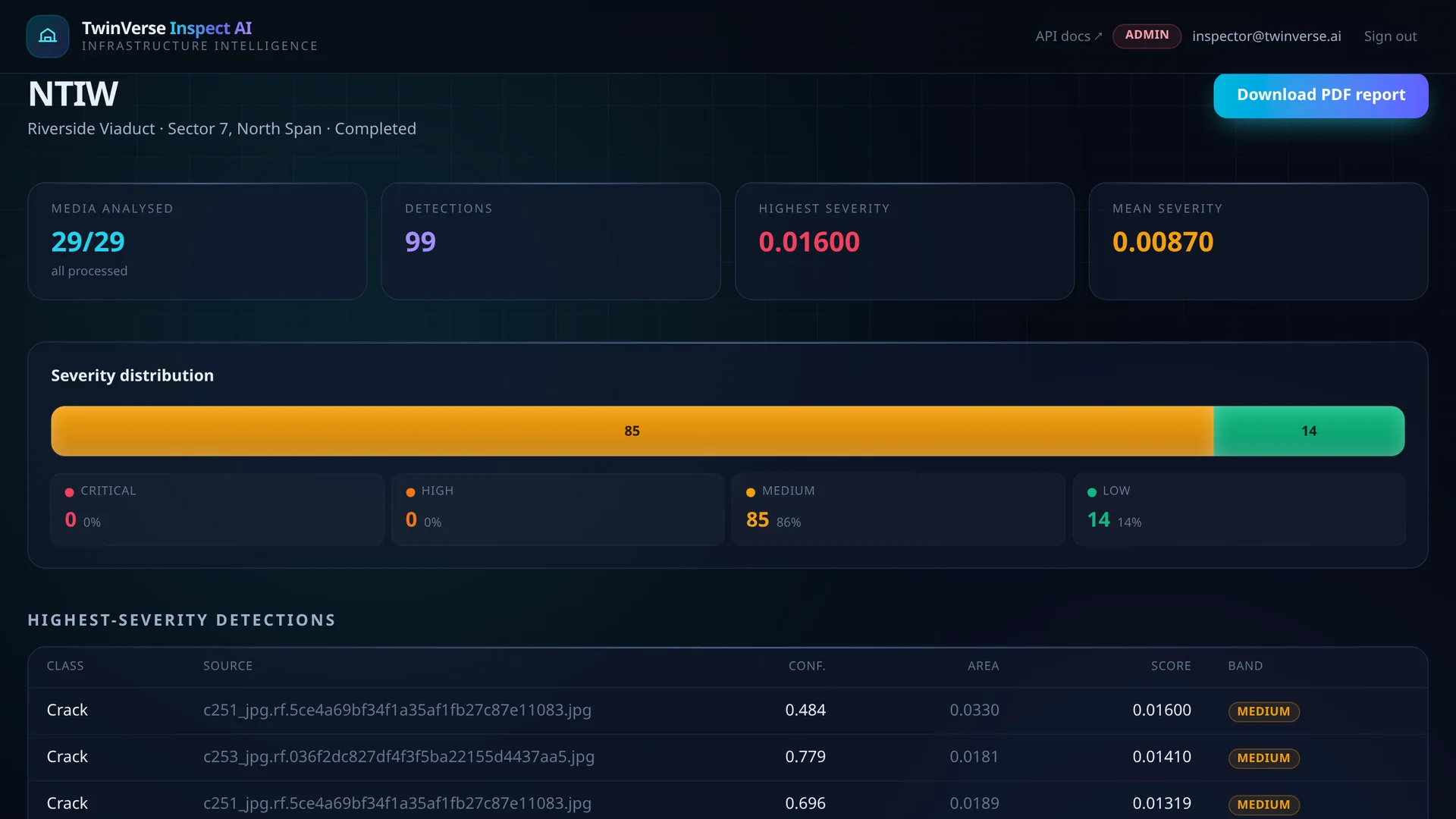
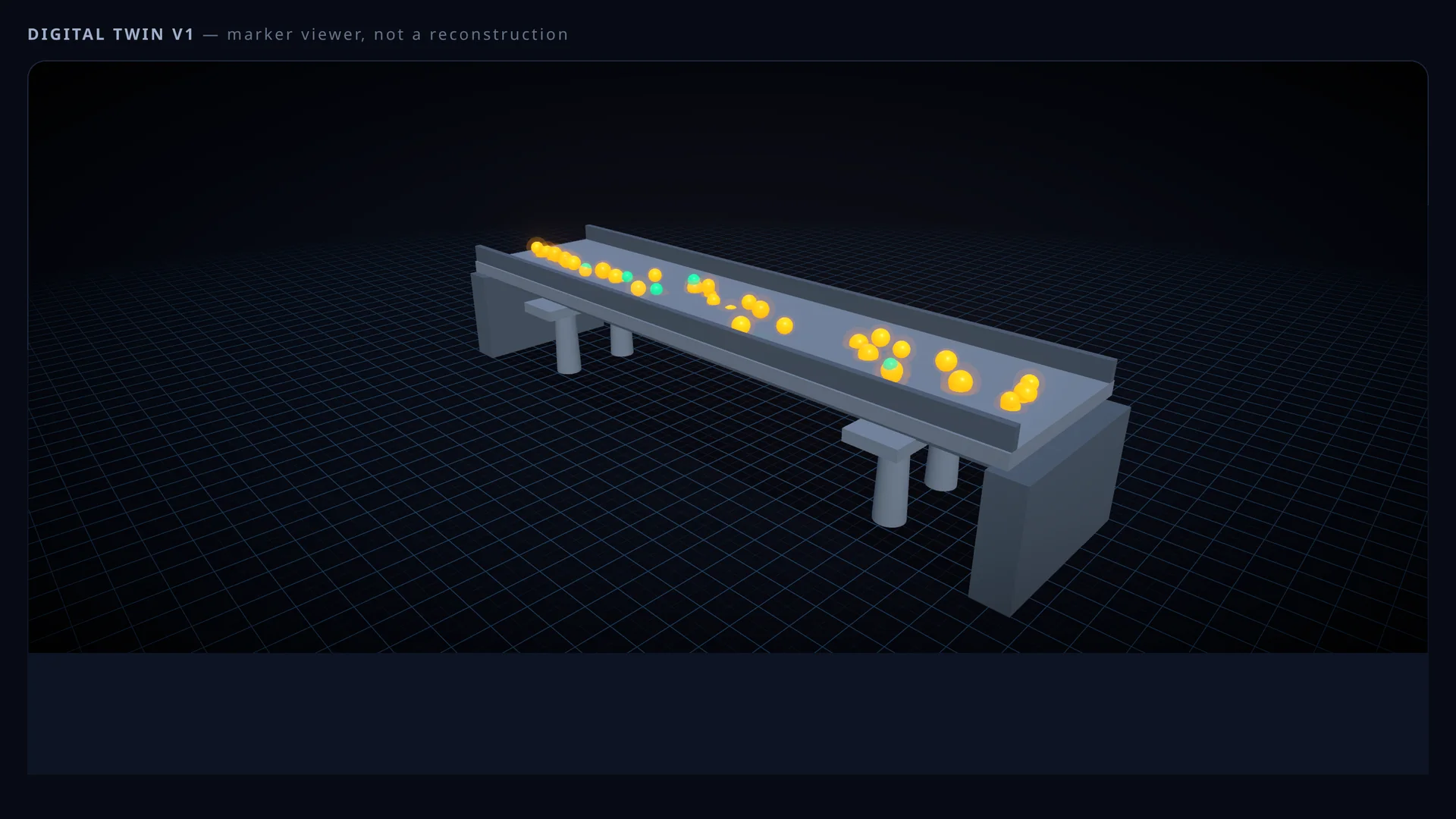
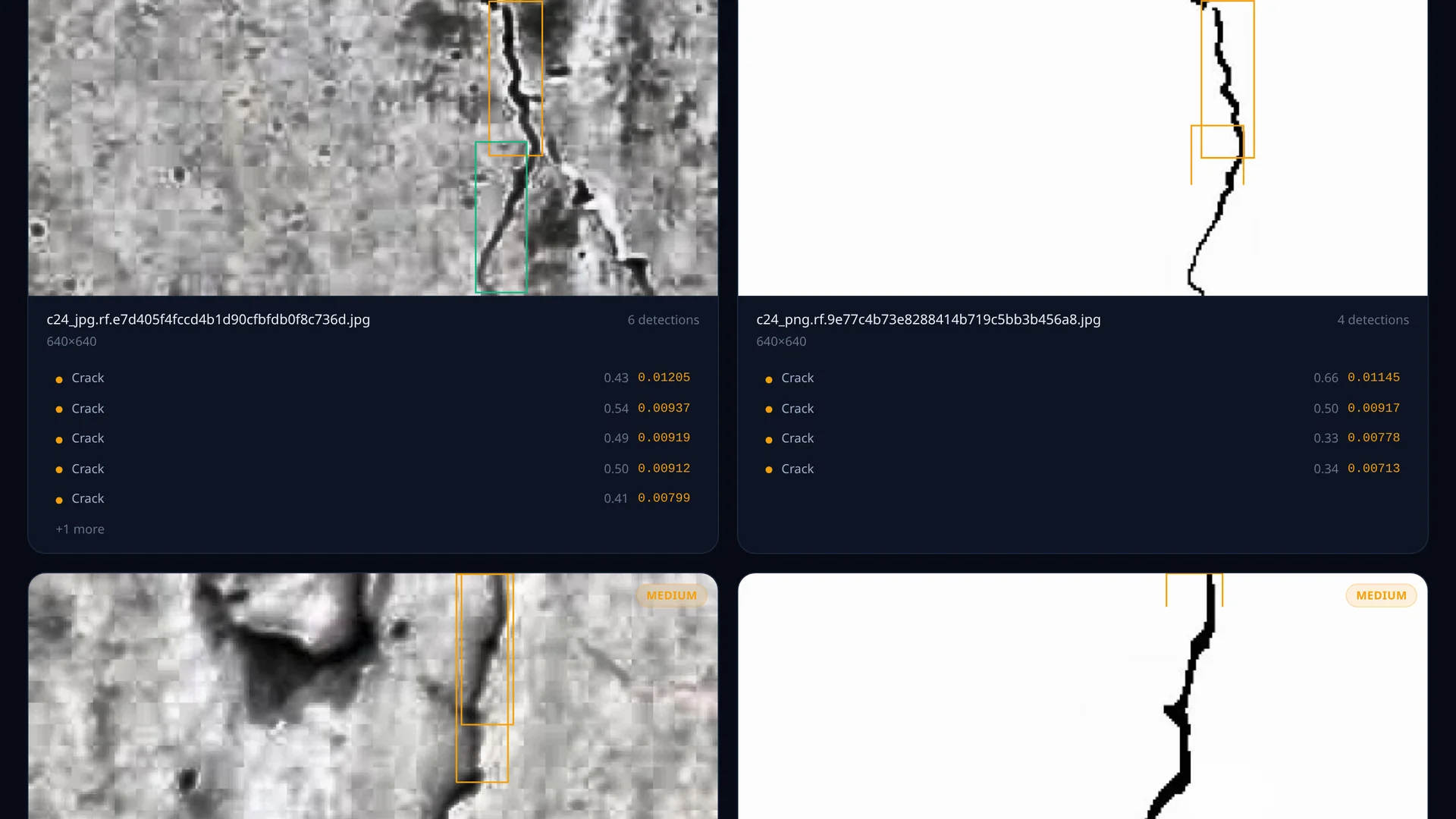
The whole survey, worst first. Nothing here is a mock-up.
Actual platform capture +How it works
01 / 02Every severity score on screen is three numbers multiplied together, and all three are stored with the finding. A reader can recompute any figure by hand from the record it came from.
Drone, CCTV, robot or a phone. Images or video — the pipeline does not care which.
A fine-tuned detector locates each crack in the frame and draws a box around it.
Defect area, model confidence and a class weight, multiplied. All three shown on screen.
Annotated images, a marker view of the structure, and a PDF anyone can forward.
What it finds today
Trained on 6,600 annotated photographs across three public datasets. It has never been shown corrosion, spalling or missing components, and will not report them.
In the productThe detector sits behind an interface, so additional defect classes are a model change rather than a rewrite of the pipeline around it.
In developmentFrames are analysed independently today, so one crack visible across ten frames counts ten times. Tracking across frames fixes it.
In developmentScreening, not an engineering assessment. The platform ranks which defect to look at first; it does not measure crack width in millimetres, which needs camera calibration or a physical scale in frame.
Validation
02 / 02A crack photograph does not record how far away the camera was, or where the crack sits in space. So the platform is tested against a simulated structure whose defects were placed at known positions — and the drone flies into the same upload endpoint a real one would use.
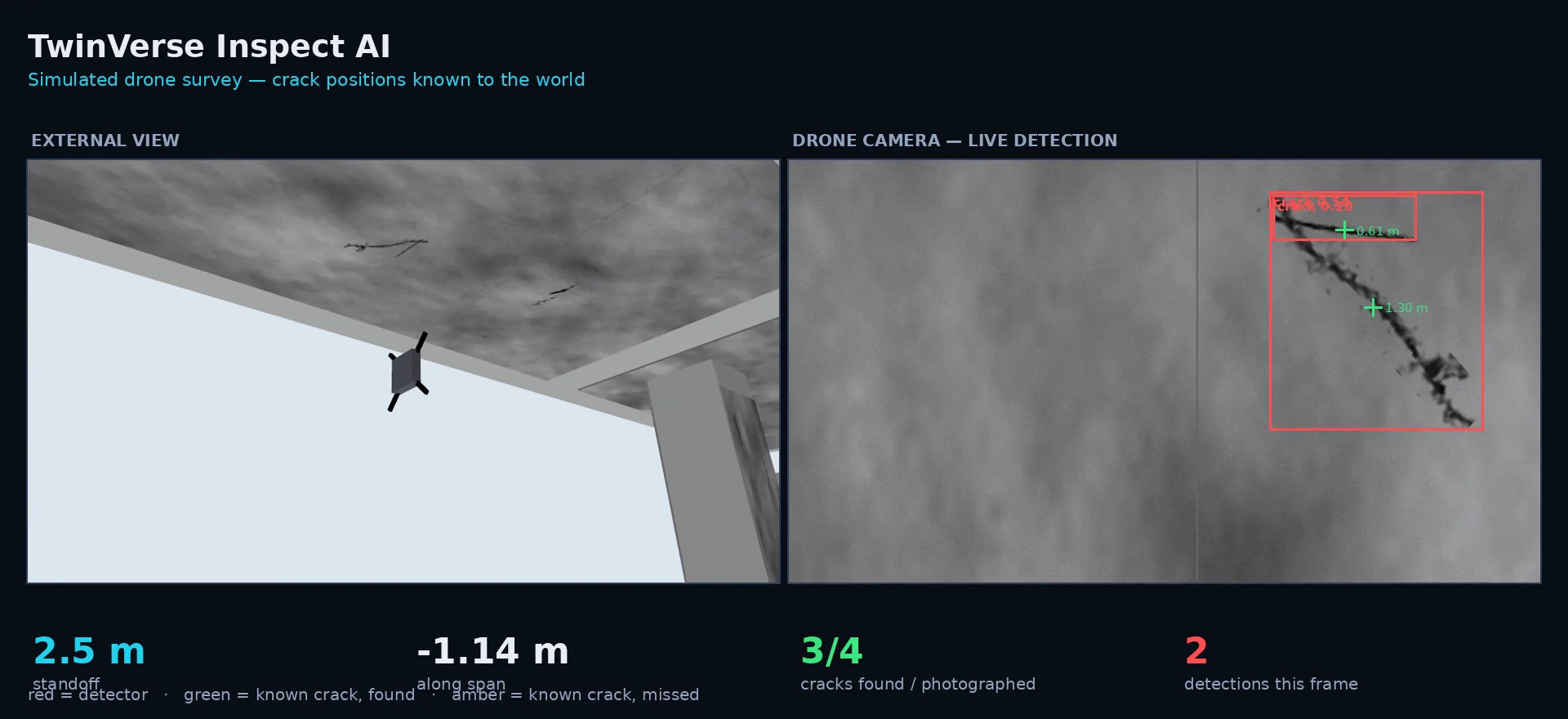
Recorded in Gazebo
Ground truth, not an estimate
Cracks cut from real photographs, placed at known 3D positions, flown at a measured standoff.
The working standoff window, measured rather than assumed. Beyond five metres a crack is too few pixels to survive; below one metre it overflows the frame and returns nothing at all.
Median distance between a placed marker and the crack it represents, over a simulated survey. A floor, not an estimate — a real platform adds its own pose uncertainty on top.
Detection ranges from 84–100% on the datasets it trained on to 56% on one it had never seen. Every figure ships with the dataset beside it.
Benchmarked against four datasets rather than one. Quoting the best of them would be a choice about which dataset to mention, so all four are published — including the weakest.
A missed crack is found at the next survey, or when something fails. A false alarm costs an engineer thirty seconds. The operating point was chosen by simulating surveys, not by maximising a score that treats the two as equal.
The simulation understates false alarms: generated concrete has no construction joints, staining or structural edges, which are exactly what triggers them in the field. Figures measured there are treated as a floor.
The parent company
AyroX LabsAyroX Labs builds the layer between a model and the physical world. RoboLab teaches robotics in the browser. Sim2Real moves a trained policy onto real hardware. TwinVerse turns what a camera sees on a structure into something an engineer can act on — and is tested in simulation before it is trusted on site.
No. It does the first pass so an engineer starts from a sorted list of findings instead of a memory card full of photographs. Every finding still requires confirmation, and the report says so on its last page.
Between 84% and 100% of cracks found on the three datasets it was trained on, and 56% on a fourth it had never seen. We publish all four rather than the best one, because an accuracy figure without a dataset beside it is not a claim anyone can check.
Deliberately. It surfaces roughly three photographs in five for a human to check, because missing a real defect costs far more than a second look. The threshold is adjustable and the whole trade-off curve is published.
Not yet on real imagery. In the product, marker placement follows capture order rather than surveyed coordinates, and the interface says so on screen. In simulation, where the camera pose is known, markers land a median 4.6 cm from the true crack — which is what the pose-aware version will do once camera pose travels with the image.
Images or video, from a drone, a fixed camera or a phone. [[TWINVERSE: confirm supported formats, per-upload file limits and maximum video length for the public offer before launch.]]
Early access
TwinVerse is in development and not yet open for public signup. If you maintain concrete structures and want to be part of the first group using it, get in touch and tell us what you are responsible for.
Register interest